

Kitchen Cabinets & Vanities Blog
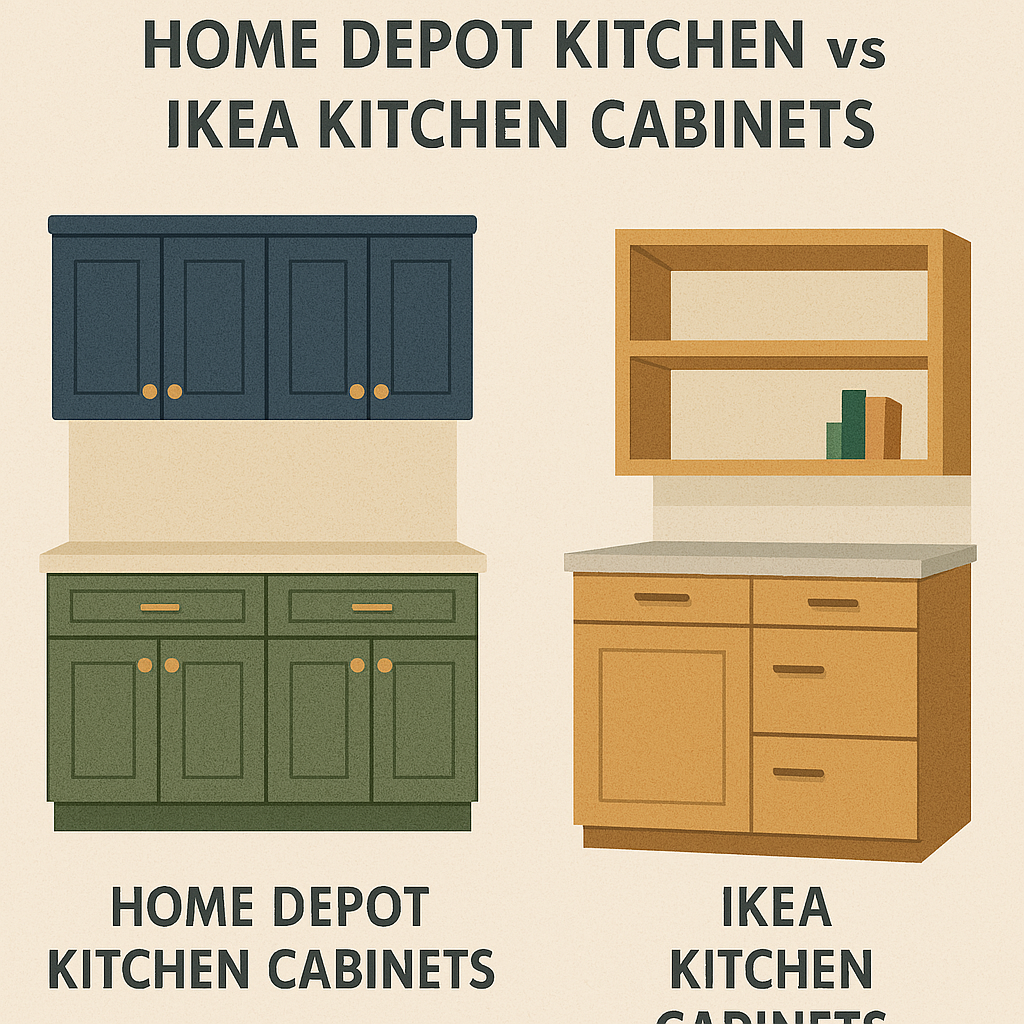
And Choosing kitchen cabinets is one of the biggest decisions in a remodel because cabinets shape almost everything else. They affect your layout, budget, storage capacity, installation timeline, and the overall feeling of the kitchen. When homeowners compare Home Depot kitchen cabinets vs IKEA kitchen cabinets, they are usually asking a bigger question: which option gives the best balance of value, style, and practicality?
The answer depends on what kind of project you are building. Some kitchens need speed and simplicity. Others need more flexibility, more personalization, or a cleaner custom look without paying for fully custom cabinetry. At House of cabinet, the best cabinet choice is never just about price. It is about choosing the path that fits your home, your routine, and your long-term expectations.
Why This Comparison Matters
On paper, both Home Depot and IKEA offer kitchen cabinet solutions for homeowners who want more control over their remodel budget than a full custom project usually allows. But the two paths are not the same.
Home Depot gives shoppers access to multiple cabinet categories, including in-stock options and factory-assembled semi-custom offerings. IKEA, by contrast, is built around its SEKTION kitchen system, which is designed as a modular planning approach with interchangeable cabinets, fronts, drawers, and interior fittings. That means this comparison is really about two different remodeling experiences, not just two places to buy cabinets.
If you understand that difference early, the rest of the decision becomes much easier.
Home Depot Kitchen Cabinets: What They Offer
Home Depot appeals to homeowners who want a broader cabinet shopping model. Instead of one single cabinet system, it offers several cabinet paths depending on budget and project level.
In-stock cabinets for speed
Home Depot is a strong option for homeowners who want readily available cabinets in standard sizes. This can be useful when you need to move quickly, keep the project simple, or avoid long lead times.
Semi-custom options for more flexibility
Another strength is the semi-custom category. This sits between stock cabinets and full custom work. It gives homeowners more choices in finish, sizing, style direction, and storage features without the full custom price tag.
Factory-assembled convenience
One of the more practical advantages in the Home Depot ecosystem is the availability of factory-assembled cabinetry in certain lines. That matters because assembly quality and installation efficiency can have a big impact on the final result. For many homeowners, the appeal is simple: fewer steps at home and a faster route to installation.
IKEA Kitchen Cabinets: What Makes Them Different
IKEA’s kitchen approach is built around system-based planning. Instead of shopping loosely across cabinet categories, homeowners work within the SEKTION system, which offers standardized cabinet boxes, multiple sizes, interchangeable fronts, and a wide range of interior accessories.
Modular planning
This is one of IKEA’s biggest strengths. The system makes it easier to build a kitchen around consistent modules, which helps with organization and visual uniformity.
Strong interior organization
IKEA kitchens are well known for making smart use of drawers, pull-outs, and interior fittings. For homeowners who care deeply about storage efficiency, that system logic can be very appealing.
Budget-conscious modern design
IKEA also tends to attract people who want a cleaner, more contemporary kitchen look at a lower entry cost. The visual language often feels modern, simple, and functional, which works well in apartments, smaller homes, and minimalist remodels.
Price and Budget: Which One Is More Cost-Effective?
For many homeowners, this is the first real filter. (Discover Cabinets Prices)
IKEA is often attractive for budget-driven remodels
IKEA is often chosen because it can provide a stylish, organized kitchen system at a more approachable price point. For budget-conscious remodels, that makes it one of the most popular starting points.
Home Depot can scale more easily across budget levels
Home Depot, on the other hand, gives you more room to move between entry-level and more upgraded cabinet lines. That can be useful when your budget is not strictly “lowest possible,” but rather “best value for the level of finish I want.”
The real cost is more than cabinet price
A traditional mistake is to compare cabinet sticker prices without thinking about the full project cost. You also need to account for:
-
assembly or pre-assembly
-
delivery and staging
-
installation labor
-
fillers, trim, panels, and accessories
-
layout limitations that may increase waste or reduce efficiency
That is why the cheaper-looking option on day one is not always the better value at the end of the project.
Design and Style: Which One Looks Better?
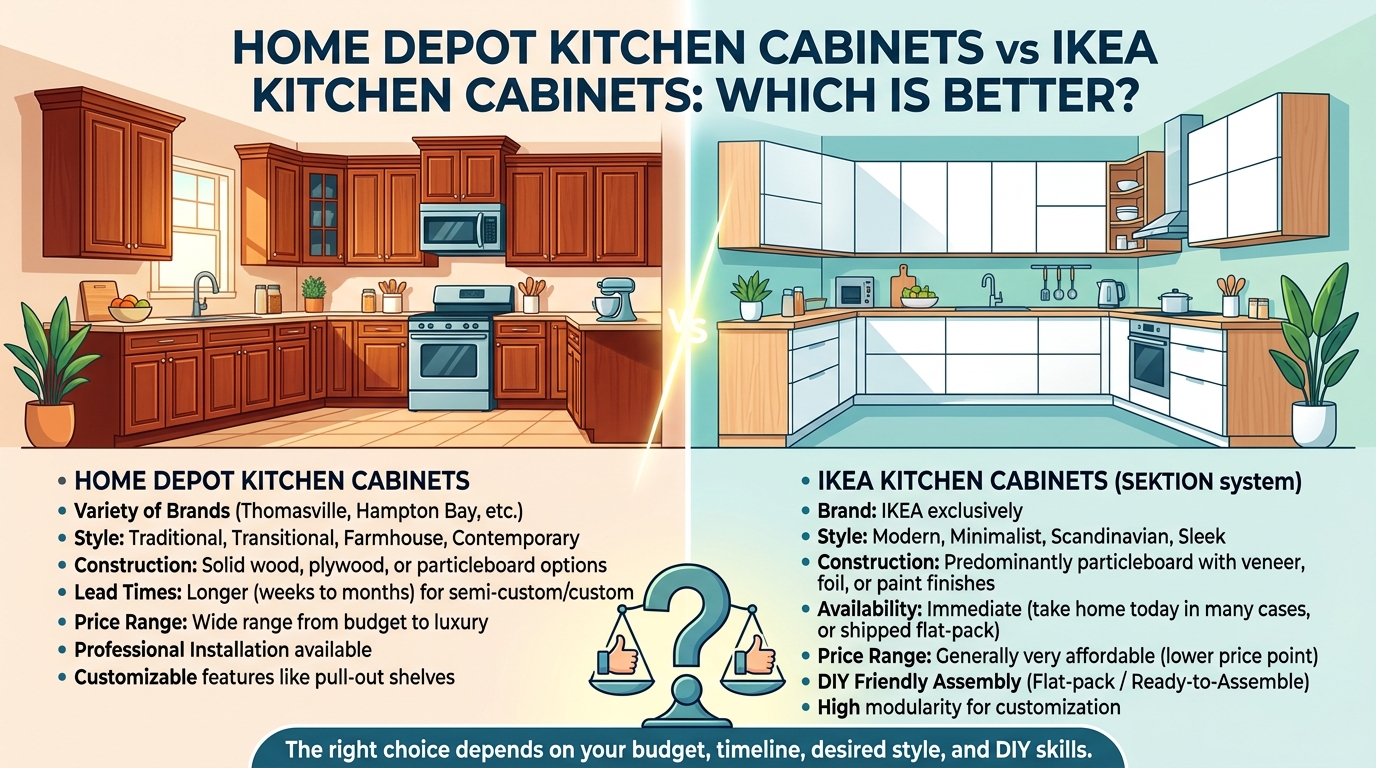
Neither brand automatically “looks better.” The final kitchen depends on selections, layout discipline, and finishing details. Still, there are clear tendencies.
IKEA usually leans more modern
IKEA kitchens often feel cleaner and more contemporary. Their modular system and simple door styles naturally fit modern and Scandinavian-inspired spaces. If you want flat panels, minimal lines, and a more restrained design language, IKEA is often a natural fit.
Home Depot can feel broader in style range
Home Depot usually gives homeowners access to a wider mix of looks, from practical stock cabinets to more classic and semi-custom styles. That can make it a better choice if your home leans transitional, traditional, or “updated classic” rather than purely modern.
The better question is style compatibility
Instead of asking which one looks better overall, ask:
-
Does this cabinet style fit my home’s architecture?
-
Will it still look right in five to ten years?
-
Can I pair it well with my counters, flooring, and backsplash?
That mindset usually leads to better design decisions than chasing what looks trendy in a showroom.
Customization and Flexibility
This is one of the biggest dividing lines between the two.
IKEA is flexible within its system
IKEA gives you flexibility, but it is structured flexibility. You work within the SEKTION framework, choosing modules, fronts, drawers, and fittings that are meant to function together.
That is excellent when your kitchen can be planned efficiently within the system.
Home Depot offers more category-based flexibility
Home Depot offers a different kind of freedom. Instead of one system, it gives you multiple cabinet routes. This can help when:
-
your kitchen has awkward dimensions
-
you want semi-custom sizing
-
you want assembled cabinetry
-
you want a style direction outside a more system-driven look
For homeowners who need more room to tailor the project, Home Depot may feel less restrictive.
Assembly and Installation
Installation is where paper decisions become real-world consequences.
IKEA often asks more from the homeowner
IKEA kitchens are popular with DIY-minded homeowners because the system is designed around planning and assembly logic. But that also means more coordination. If you are not comfortable with assembly, leveling, sequencing, and install details, the project can become more demanding than expected.
Home Depot can reduce installation friction
Because Home Depot offers assembled options in certain lines, it may reduce on-site labor and simplify the path to installation. That does not automatically make it better, but it does make it attractive for homeowners who want fewer moving parts.
The truth most homeowners learn late
Cabinets are not just purchased. They are measured, delivered, staged, assembled, leveled, anchored, trimmed, adjusted, and finished. The easier your cabinet system makes that chain, the smoother your remodel usually feels.
Durability and Long-Term Use
Homeowners often ask which one is more durable, but durability is never about the brand name alone. It comes from construction quality, hardware, finish performance, and how well the kitchen is installed.
IKEA’s strength: organization and consistency
IKEA performs well when homeowners value organized interiors, smart drawer systems, and a highly planned modular layout.
Home Depot’s strength: broader construction paths
Home Depot gives access to cabinet types that may better suit homeowners looking for assembled cabinetry, semi-custom construction, or a different finish level.
What you should actually evaluate
Whichever path you choose, pay attention to:
-
cabinet box material
-
drawer construction
-
hinge and slide quality
-
finish durability
-
how trim and fillers are handled
-
whether the layout supports your real daily use
That is where long-term satisfaction is decided.
Which One Is Better for Different Types of Homeowners?
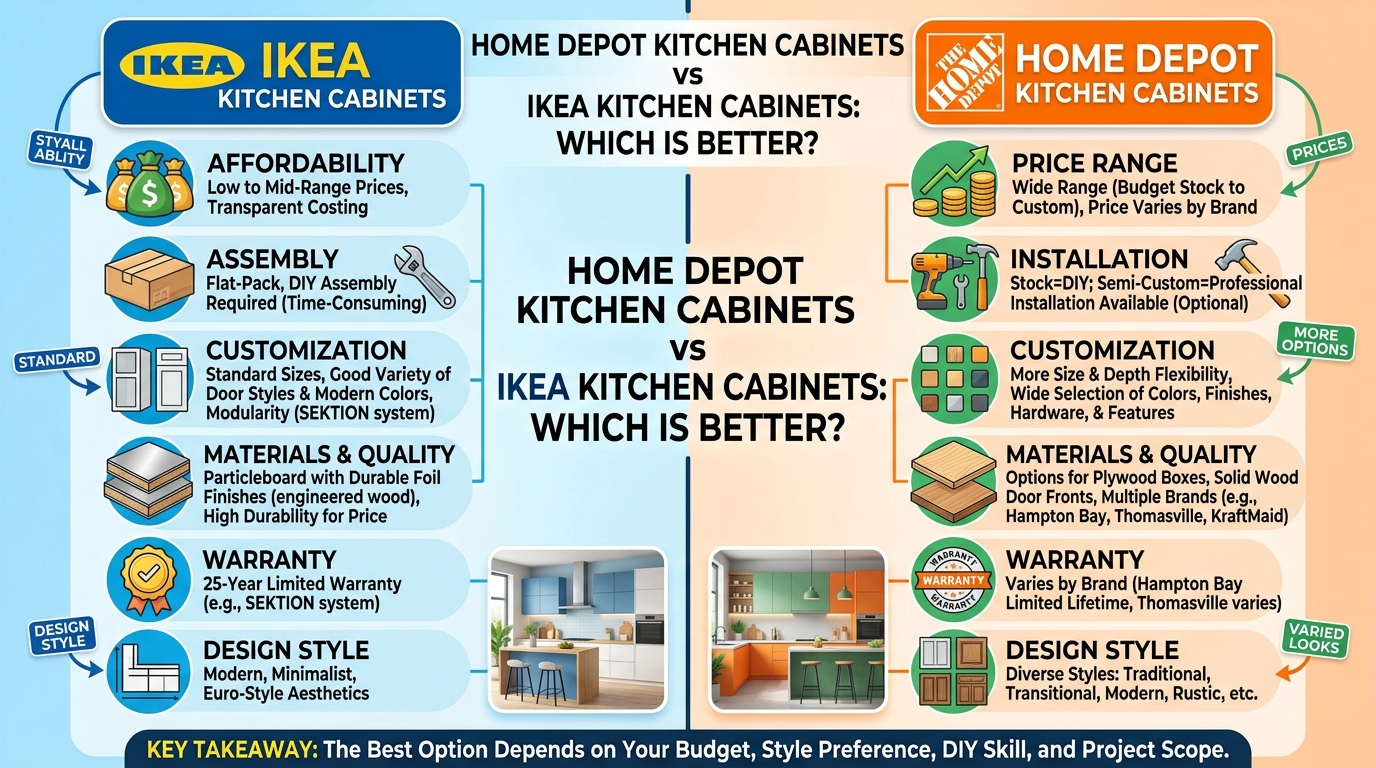
Choose IKEA if:
-
You want a modern, system-based kitchen
-
Budget control is a major priority
-
You like modular planning and storage accessories
-
You are comfortable with a more DIY-oriented path
Choose Home Depot if:
-
You want more cabinet categories in one shopping path
-
You may need semi-custom flexibility
-
You prefer assembled options
-
You want a style range that can lean more classic or transitional
And Choose based on project type, not brand recognition
A small urban kitchen and a large suburban family kitchen do not need the same cabinet strategy. The smartest remodelers do not ask which brand is more famous. They ask which cabinet path fits the room, the budget, and the installation reality.
Final Verdict
When comparing Home Depot kitchen cabinets vs IKEA kitchen cabinets, there is no single universal winner. IKEA is often a strong choice for homeowners who want a modern, modular, budget-aware kitchen with smart organization. Home Depot is often the stronger option for homeowners who want more cabinet categories, assembled choices, and a path that can scale more easily from simple stock cabinets to semi-custom upgrades.
At House of cabinet, the better cabinet is the one that fits the project honestly. If your kitchen needs efficiency, structure, and strong budget discipline, IKEA can make sense. If your kitchen needs more flexibility, a broader style range, and a smoother assembled-cabinet route, Home Depot may be the better fit. In the end, a well-planned kitchen always beats a famous name chosen for the wrong reasons.